The hidden beauty of multiplication tables
https://plus.maths.org/content/sites/plus.maths.org/files/articles/2017/multitables/table6.png
 We will add a row of
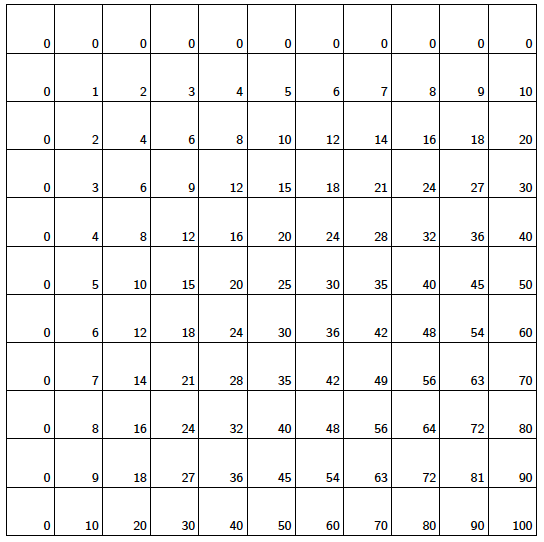
  at the top and a column of on the left. This still gives a consistent table — the first row and column contain multiples of
  , the second row and column contain multiples of
  , the third row and column contain multiples of
  , etc — and it will provide a nice frame for our patterns.
 : we assign the colour blue to every square in the multiplication table that is a multiple of
  . (The number
  is a multiple of , so all the squares are blue.)

 are coloured red, and those that are multiples of
  are coloured orange (with the orange taking precedence over the red in the case of multiples of both and , that is, multiples of
  ).
).
 , orange to numbers that are multiples of
  , and yellow to numbers that are multiples of
  . If a cell is a multiple of two of these numbers (eg
  ) then it will be assigned the colour of the larger of these two numbers (orange in the example). We will stick to this convention for the rest of this article.
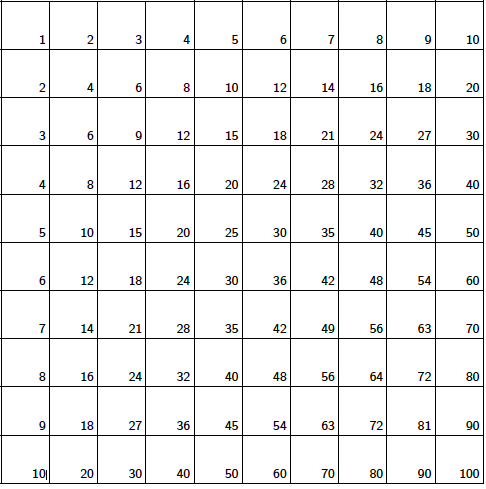
Let us start with the standard multiplication table. The table below contains the numbers 1 to 10 in the first row and the first column. Any other square contains the product of the first number in its row and the first number in its column.
at the top and a column of on the left. This still gives a consistent table — the first row and column contain multiples of , the second row and column contain multiples of , the third row and column contain multiples of , etc — and it will provide a nice frame for our patterns.
In the following, we will colour the squares of the multiplication table that correspond to multiples of a number  for various values of . And we’ll discover some beautiful symmetries.
for various values of . And we’ll discover some beautiful symmetries.Single multiples
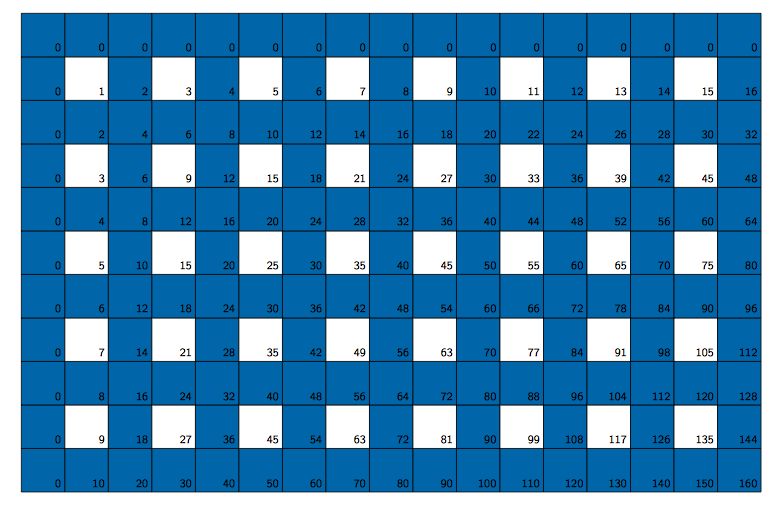
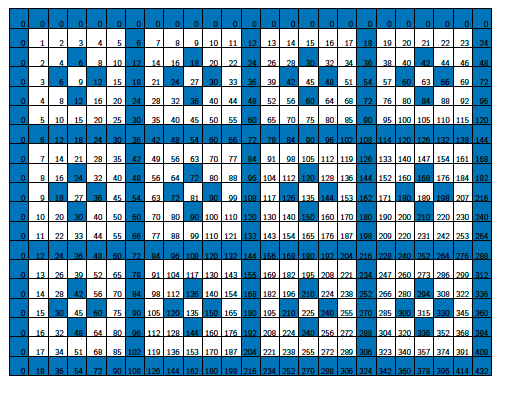
We begin with: we assign the colour blue to every square in the multiplication table that is a multiple of . (The number is a multiple of , so all the squares are blue.)
Here we have extended the table a bit so that it runs until the number 15 in the horizontal direction. Indeed, since the complete multiplication table on positive integers is infinite on two sides, we will continue to tweak the dimensions of the tables in what follows to display the emerging patterns more clearly.
Note that the whole pattern above can be pieced together using the fundamental building block:
The fundamental building block contains  cells of the multiplication table. The squares defined by the white cells in the pattern consist of
cells of the multiplication table. The squares defined by the white cells in the pattern consist of![\[ (k-1)^2=(2-1)^2=1 \]](https://plus.maths.org/MI/db5d24bd1132ea957603690494c23003/images/img-0002.png) |
cells.
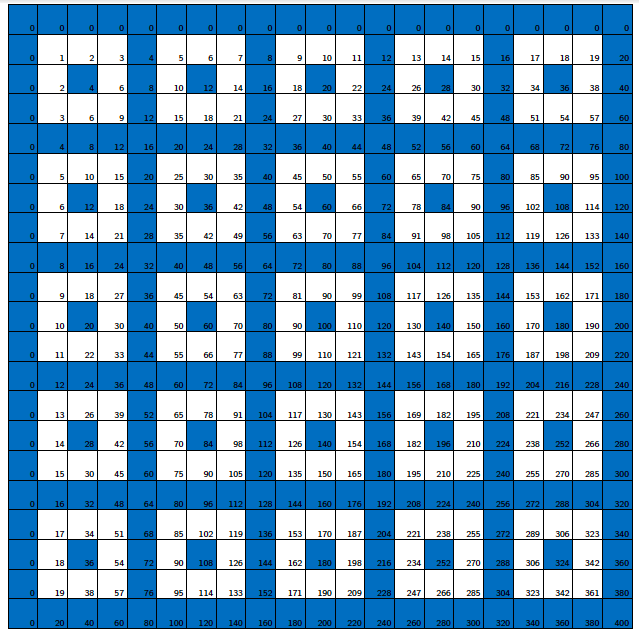
Below are two more images in which the multiples of a number  have been coloured blue. Can you tell what the value of is in each case? Can you tell what the fundamental building blocks are, how many cells they contain, and how many cells make up the squares defined by the white cells? You can post your answers in the comment field below — in case you can’t work them out, we’ll publish the answers in a few weeks’ time.
have been coloured blue. Can you tell what the value of is in each case? Can you tell what the fundamental building blocks are, how many cells they contain, and how many cells make up the squares defined by the white cells? You can post your answers in the comment field below — in case you can’t work them out, we’ll publish the answers in a few weeks’ time.Multiple multiples of consecutive numbers
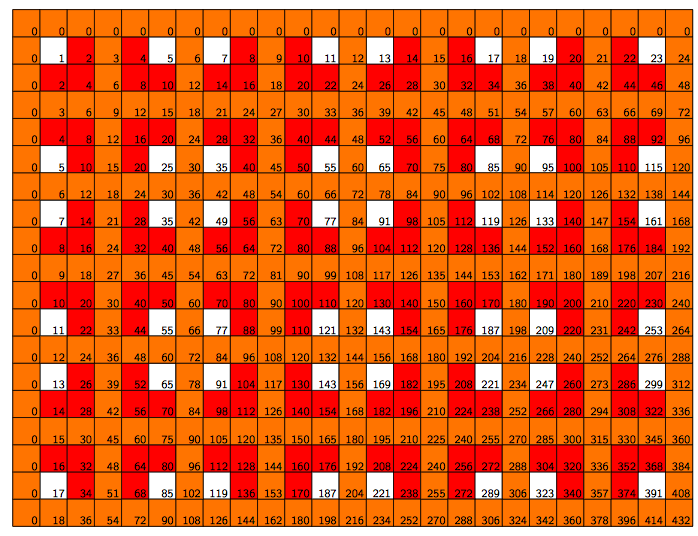
A more interesting pattern emerges if we use multiple multiples, and corresponding to them, multiple colours. In the following figure, the numbers that are multiples of are coloured red, and those that are multiples of are coloured orange (with the orange taking precedence over the red in the case of multiples of both and , that is, multiples of ).
This gives the following pattern.
Note that this time our fundamental building blocks consist of  little squares, which makes sense, because
  is the least common multiple of
  and
and  . The symmetry emerges from repeated copies of a
  square with a nice four-fold symmetry.
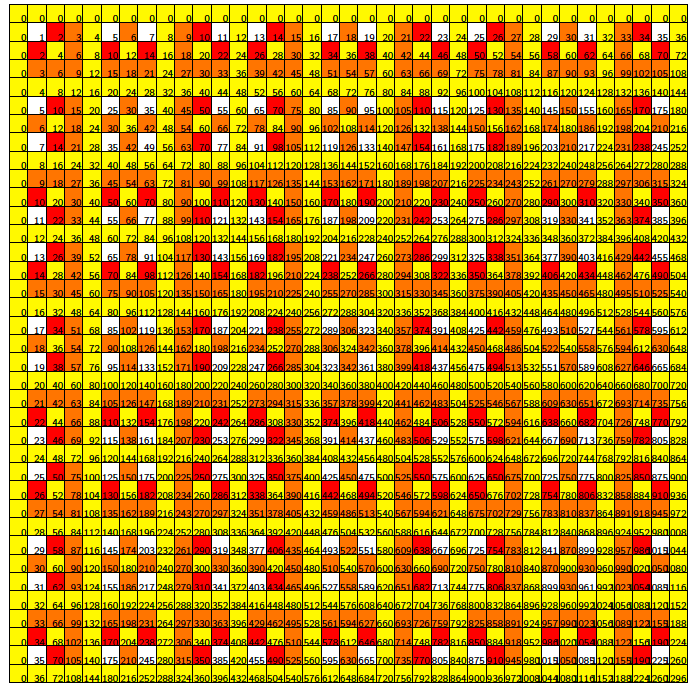
The next figure takes this a step further, assigning red to numbers that are multiples of little squares, which makes sense, because is the least common multiple of and . The symmetry emerges from repeated copies of a square with a nice four-fold symmetry., orange to numbers that are multiples of , and yellow to numbers that are multiples of . If a cell is a multiple of two of these numbers (eg ) then it will be assigned the colour of the larger of these two numbers (orange in the example). We will stick to this convention for the rest of this article.
The hidden beauty of multiplication tables
![The hidden beauty of multiplication tables]() Reviewed by . blogmathappily
on
4:23 م
Rating:
Reviewed by . blogmathappily
on
4:23 م
Rating:

 المشاركات

